Tuesday, November 27, 2018

Monday, November 12, 2018


Thursday, November 1, 2018
Assignment 3b : Film Viewing Practice Exam
I0312
Christopher Charlestin
AICE Movie Exam
After viewing the first 5 minutes of the movie Agent Carter, Marvel One-Shots, 2013, dir. Louis D’Esposito, the misc-en-scenes: costumes, settings, lighting, and acting help the audience understand the plot of the film. The setting of the film takes place somewhere in the northeastern region in the United States of America taking place in the early twentieth century, a year after the first world war. Remember the setting is key to the film to help set the idea of women were treated when brought up the idea of them doing a "man's job". In addition to the setting, The costumes and make-up of the characters in the film hint that the story is taking place in the early 1910s since all of the employees in the S.H.I.EL.D are dress formally. Going further with the mise-en-scene, the acting from the lead actress playing as Peggy Carter uses non-method acting and method acting to keep the audience engage and make it seem she is really living as the character she plays, for example, the actress uses face expression and body language to show her annoyance when her boss continues to give her lowly paperwork to do even though she has the skills to succeed in on field assignments but refuse to because of the idea that she is a woman still grieving a year later and unable to continue to do work efficiently. The actress playing Peggy Carter also sounds very sarcastic, confidence and informal which is key to the clip because she is supposed to sound like that selling her role. The mise-en-scène describes of what can be view in the given clip and goes even further to give an idea of the plot of what the entire film is about.
In the movie clip; simultaneity, leitmotif, and parallelism are few masters edits use in the first five minutes of the movie Agent Carter. Parallelism is using to connect two seemingly unrelated scenes by cutting between them and focusing on parallel features, for instances, at the beginning of the film
a man is about to crash in a jet as Peggy tries to find a way to get him to reroute safely but he declines and accepts his fate, then a few minutes after the scene the audience see Carter working a year later after the event and pulls a picture of the same man, showing the connection between the two scenes. For leitmotif , the red flashing light seems to be a reoccuring them in the first five minutes of film to indicate some sort of mission is being requested, from the timecode of 0:51-1:17 of the video, a mission on the zodiac was requested to headquarter and again red flashing light and a ringing noise indicate another zodiac mission but this time the main protagonist on the timecode of 2:56-3:17. Following with the simultaneity editing technique, a technique used to cut between two events happening at the same time, this is used at the beginning of the film switching from the man piloting a jet and Peggie trying to find a way to help the man.
During the first five minutes of Agent Carter, there is many sound devices, camera shots, and angles movement that is used. The movie starts out with Nonsimultaneous sound by giving a radio call between the man and the jet and Peggy during the opening title screen, direct sound or diegetic sound are used as dialogues between characters, post-synchronization dubbing which was used for punching sounding effects when Peggie intrifilted the zodiacs base while knocking out his cronies, in other words, these sound edits make the film feel more realistic. For camera shots, many close shots and two shots were taken multiple times in the film so we can see the characters interact waist level, for example, when in the headquarters the men get together and interacting on missions catching the attention of Carter who feels should be in the feild instead of doing paperworks and statistics. Camera movements like the panning movement is use to transition the scene to another setting ot set up a establishing shot, to give an idea 0:39 pan out to a black screen to show a city and on 3:19 it pans to night as carter prepares to break into the crimisals hideout. Camera movements are ideal for transitioning.
Without these filming elements, the five minutes given from Agent Carter would not have accomplish of what it intend to do; without the misc-en-scene the audience would likely not have too much of the point of the scene right away, without the sounds and camera angle the video would be too dull, and without the master edits the movie would not be as clever.
Christopher Charlestin
AICE Movie Exam
After viewing the first 5 minutes of the movie Agent Carter, Marvel One-Shots, 2013, dir. Louis D’Esposito, the misc-en-scenes: costumes, settings, lighting, and acting help the audience understand the plot of the film. The setting of the film takes place somewhere in the northeastern region in the United States of America taking place in the early twentieth century, a year after the first world war. Remember the setting is key to the film to help set the idea of women were treated when brought up the idea of them doing a "man's job". In addition to the setting, The costumes and make-up of the characters in the film hint that the story is taking place in the early 1910s since all of the employees in the S.H.I.EL.D are dress formally. Going further with the mise-en-scene, the acting from the lead actress playing as Peggy Carter uses non-method acting and method acting to keep the audience engage and make it seem she is really living as the character she plays, for example, the actress uses face expression and body language to show her annoyance when her boss continues to give her lowly paperwork to do even though she has the skills to succeed in on field assignments but refuse to because of the idea that she is a woman still grieving a year later and unable to continue to do work efficiently. The actress playing Peggy Carter also sounds very sarcastic, confidence and informal which is key to the clip because she is supposed to sound like that selling her role. The mise-en-scène describes of what can be view in the given clip and goes even further to give an idea of the plot of what the entire film is about.
In the movie clip; simultaneity, leitmotif, and parallelism are few masters edits use in the first five minutes of the movie Agent Carter. Parallelism is using to connect two seemingly unrelated scenes by cutting between them and focusing on parallel features, for instances, at the beginning of the film
a man is about to crash in a jet as Peggy tries to find a way to get him to reroute safely but he declines and accepts his fate, then a few minutes after the scene the audience see Carter working a year later after the event and pulls a picture of the same man, showing the connection between the two scenes. For leitmotif , the red flashing light seems to be a reoccuring them in the first five minutes of film to indicate some sort of mission is being requested, from the timecode of 0:51-1:17 of the video, a mission on the zodiac was requested to headquarter and again red flashing light and a ringing noise indicate another zodiac mission but this time the main protagonist on the timecode of 2:56-3:17. Following with the simultaneity editing technique, a technique used to cut between two events happening at the same time, this is used at the beginning of the film switching from the man piloting a jet and Peggie trying to find a way to help the man.
During the first five minutes of Agent Carter, there is many sound devices, camera shots, and angles movement that is used. The movie starts out with Nonsimultaneous sound by giving a radio call between the man and the jet and Peggy during the opening title screen, direct sound or diegetic sound are used as dialogues between characters, post-synchronization dubbing which was used for punching sounding effects when Peggie intrifilted the zodiacs base while knocking out his cronies, in other words, these sound edits make the film feel more realistic. For camera shots, many close shots and two shots were taken multiple times in the film so we can see the characters interact waist level, for example, when in the headquarters the men get together and interacting on missions catching the attention of Carter who feels should be in the feild instead of doing paperworks and statistics. Camera movements like the panning movement is use to transition the scene to another setting ot set up a establishing shot, to give an idea 0:39 pan out to a black screen to show a city and on 3:19 it pans to night as carter prepares to break into the crimisals hideout. Camera movements are ideal for transitioning.
Without these filming elements, the five minutes given from Agent Carter would not have accomplish of what it intend to do; without the misc-en-scene the audience would likely not have too much of the point of the scene right away, without the sounds and camera angle the video would be too dull, and without the master edits the movie would not be as clever.
Saturday, October 27, 2018
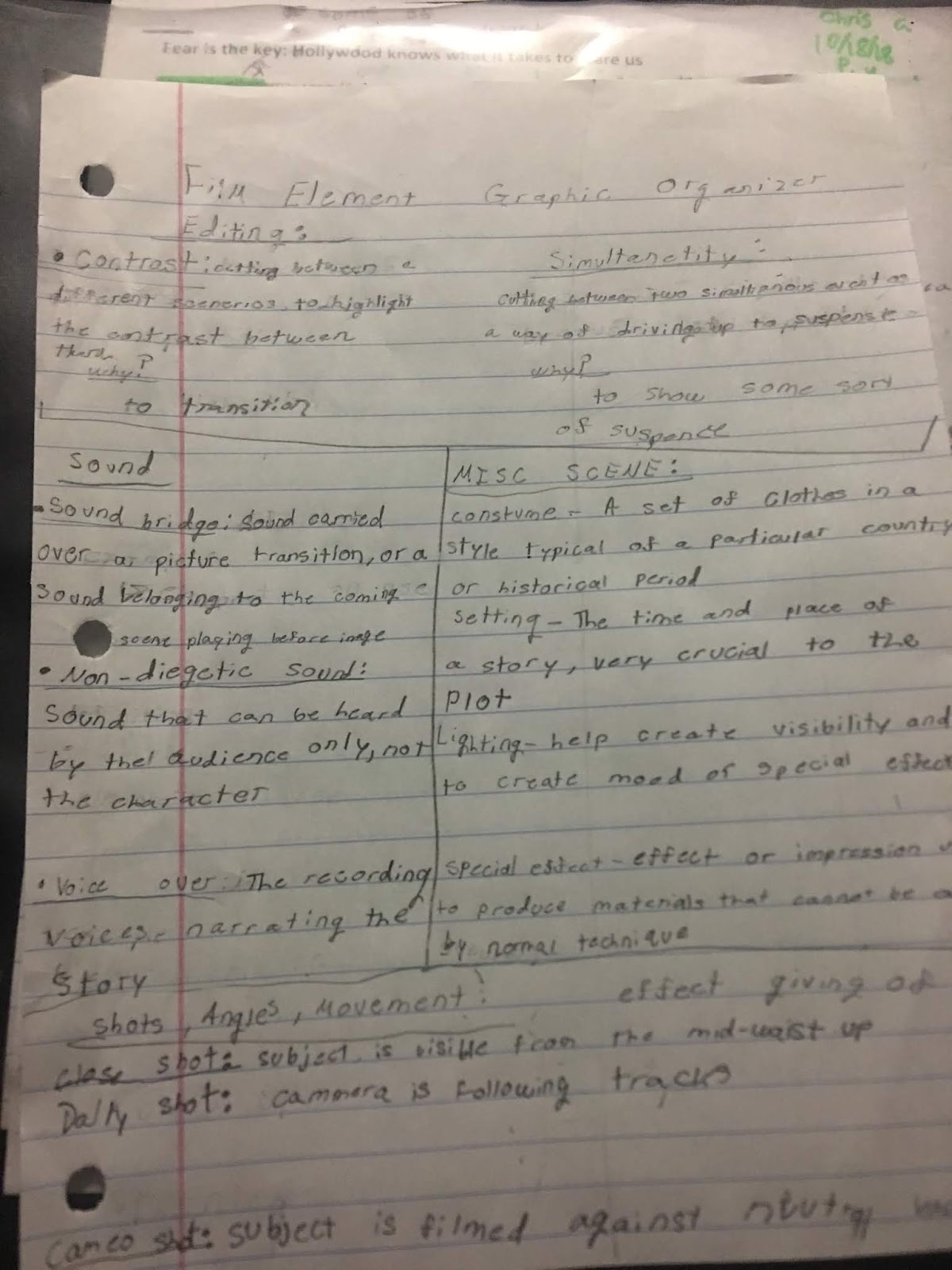
Assignment 2B : Film Elements Graphic Organizer

Sunday, October 21, 2018
Assignment 1b : MISE-EN-SCENE in Harry Potter and the Deathly Hallows
For this assignment, I have chosen to watch the movie "Harry Potter and the Deathly Hallows pt 2" to analyze aspects of mise en scène: costume, setting, staging, and lighting. I chose this film to analyze because it is very easy to analyze, I believe I have seen an advertisement for the universal studio, and due to the fact that I ain't have anything better to watch.
SETTING:
The set designers from this movie chose to use multiple different settings, but all relates back to the idea that the movie takes place in a fantasy world, For instance; Hogwart, Gringotts wizardry bank, and Diagon Alley. To go more in depth, the beginning of the movie kicks thing off moments where part one ended, on the beach where Harry and friends are burying Dobby the Elf, who sacrifices himself to save the crew, giving off a more greyish-dark and serious tone that follows throughout the majority of the film. The setting of the movie is important because it creates both a sense of place and a mood which helps the audience pick up the Harry Potter film is going to be very dramatic and very magical.
LIGHTING:
Majority of the film was in the low-key lighting due to the fact to match the tone of the main theme and story. Elaborating on the last statement, since the main antagonist, Lord Voldemort, became introduced in the cinematic series, the plot became to take a more dark tone rather than being as joyous and vibrant, such as it was in the first three films due to the reason there has not been a major threat yet. Low-key lighting is the fill light at a very low level, causing the frame to be cast with large shadows. This causes stark contrasts between the darker and lighter parts of the framed image, and for much of the subject of the shot to be hidden behind in the shadows, making this lighting even more efficient since the protagonist are being hunted by the dark forces as Voldemort grows more powerful in the wizarding world. Overall, this lighting just does the film more justice then the other lighting choices, such as three-Point lighting (although was sometimes used) and high-key lighting (which was rarely used) because it just set the mood for the movie from the beginning of the movie to the final battle in the movie.
COSTUME:
The use of costume conveyed during the entire film help to convey the plot of the story: a group of young and rogue wizard on the loose for seven Horcruxes to defeat a murderous and manipulative dark wizard out to rule the magic word. In other words; Harry, Ron, and Heronime are all wearing dirty clothes and looked exhausted, which may be the intention the makeup artists were going for. However all the other wizards and magical lifeforms all seemed to be wearing robes and hats, since the setting mostly takes place in the wizarding world. the costume is an important part the film because it helps to apply to the setting and plot.
STAGING AND ACTING:
Better explain from the website of college and media studies: " An actor or actress’s performance can make or break a movie regardless of how engaging the story is or how well the editing was done etc… It is the actor’s duty to bring his or her character to life within the framework of the story, and his emotional input dictates how strongly the audience feels about the film. Acting depends upon gesture and movement, expression and voice."
I felt like the whole acting from the entire cast was flawless as the movie progress you feel a certain way about certain characters, or in simpler terms, you either hate them or love them. There is a reason after all how the Harry Potter cinema has over eight movies. The Staging felt realistic also as half the scenes were taking in real life locations but sometimes on set too.
Monday, October 8, 2018
Assignment 8
5 Master Edits Post With Sound
https://www.youtube.com/watch?v=UYZV52SyqK4
the link above is my original masterpiece a few weeks back, but this time with more sound! I will not be explaining the scenes demonstrating each editing technique but rather how the noises, music and et cetera change the scene up and how it affects the human emotions.
https://www.youtube.com/watch?v=UYZV52SyqK4
the link above is my original masterpiece a few weeks back, but this time with more sound! I will not be explaining the scenes demonstrating each editing technique but rather how the noises, music and et cetera change the scene up and how it affects the human emotions.
- SOUND SOURCE:
- SOUND EDITING:
Friday, October 5, 2018
Assignment 7: Five Editing Techniques in the Boondocks
Five Editing Techniques Found in "The Boondocks"
Producer: Aaron McGrudder
(No audio included)
LEITMOTIF: A leitmotif shot includes a recurring theme, where in this case the theme was a repeated scene. So in the following clip above, The theme seems to be the ice cream melting. As the ice cream melts it helps the audience realize that a lot of time has passed as Usher and Sarah continue to have pictures and talk (In other words they are flirting) in front of Tom, who is waiting patiently so Sarah and Tom may continue their anniversary dinner.
CONTRAST: A contrast shot includes two differing shots to make the difference between them clearer. In this case, the contrast is a scene where Tom seems to be enjoying the anniversity dinner so much he burst out singing to his wife Sarah mistakenly taken her smile as if she is also having a great time, while during this scene the shots taken of Sarah shows that she is embarrassed, bored, cringing and rather be with R&B singer Usher. This contrast highlights their definition of having a great time due to the fact Sarah finds Tom is so boring and really lame, as shown through her reaction and mood in the entire scene, meanwhile Tom is having a hoot by being a straight up loser.
Parallelism: This editing technique bring two different scenes together by highlighting both their differences and the similarities between the two. In this video, Tom is doing some sort of weird musical video sequence as he get flashbacks of being kicked out of the house. These two scenes are similar as they relate to the plot: Tom being kicked out because of his insecurity of Usher and Sarah. They differ however because the Flashback scene shows us actually seeing Tom being kicked while that whole dance sequence was him singing about his hurt feelings.

Symbolism: A symbolism shot moves from one scene to the next where there is a symbolic connection between the shots. In this case, the symbolic transition lies between the Usher shirt on Tom's daughter, Jasmine, and the actual person Usher himself when he got slapped by Tom. Thus, the symbolism of the shirt panning out to reveal Usher reaction of getting slapped is a clever way of transitioning use with the symbolism technique (had to use a picture because the video kept getting corrupted).
Simultaneity: The Simultaneity editing technique uses two scenes that occurs at the same exact time or around the same time period.Normally, simultaneity is use to build suspense towards the audience. In this case, if these videos ever load you should be able to see that a crazy insecure chick is talking to a friend giving her terrible and illegal advice to deal with her suitors, while the suitor and his two grandchildren are hiding in the bathroom discussing how to get rid of her as she grows more dangerous taking the advice.
Subscribe to:
Posts (Atom)